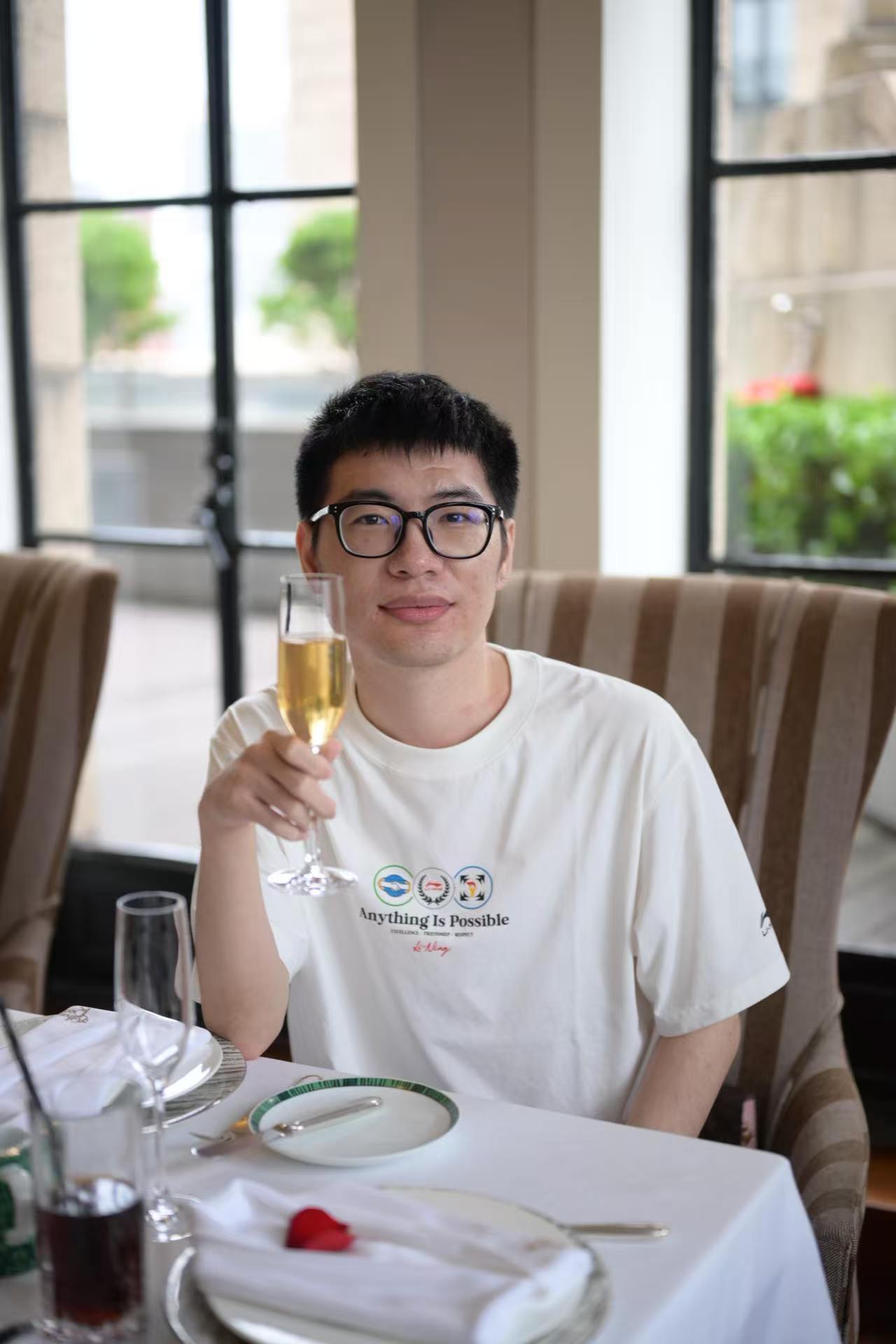
Portrait of Xucheng Yu

Xucheng Yu

Trustworthy AI • LLM Safety and Reliability • Agentic and Multi-Agent Systems

M.Eng. in Electrical & Computer Engineering, University of Illinois Urbana-Champaign

xy63@illinois.edu · +86 187 6288 3800 · Urbana-Champaign, IL

About

I am a researcher working on trustworthy foundation models. My work centers on adversarial robustness, auditable reasoning and evaluation, and reliable agentic and multi-agent decision-making under uncertainty. I am drawn to the questions of how large language models behave when they are pushed, probed, and deployed at scale — and how we can make them safer and more dependable in the process.

I recently completed my Master of Engineering in Electrical and Computer Engineering at the University of Illinois Urbana-Champaign (GPA 4.0/4.0), where I work with Dr. Haohan Wang and Dr. Huan Zhang. Before UIUC, I earned dual B.Sc. degrees in Mathematics with Computer Science from the Guangdong Technion — Israel Institute of Technology (GTIIT) and the Technion — Israel Institute of Technology, graduating on the Dean's List. Alongside research, I build production systems — from GEO auditing platforms to natural-language tool orchestration.

News

Publications & Manuscripts

Author names in bold indicate my contribution. Submitted manuscripts are under peer review.

  1. SCI-Defense: Defending Manipulation Attacks from Generative Engine Optimization
    Xucheng Yu, Haibo Jin, Huimin Zeng, Haohan Wang
    Submitted to NeurIPS 2026 arXiv:2605.21948
  2. MonitorBench: A Comprehensive Benchmark for Chain-of-Thought Monitorability in Large Language Models
    Han Wang, Yifan Sun, Brian Ko, Mann Talati, Jiawen Gong, Zimeng Li, Naicheng Yu, Xucheng Yu, Wei Shen, Vedant Jolly, Huan Zhang
    Accepted at COLM 2026
  3. Understanding Content Moderation in Large Language Models through Restricted Books: From Refusal to Warning
    Xucheng Yu, Emily Knox, Haohan Wang
    Accepted at AIES 2026
  4. HEART: Harness Engineering in LLM Tool Use via Agent-Native Reusable Tool Primitives
    Haibo Jin, Suijin Wang, Xucheng Yu, Haojing Luo, Haohan Wang
    Submitted to NeurIPS 2026
  5. Prompt Stability Matters: Evaluating and Optimizing Auto-Generated Prompt in General-Purpose Systems
    Ke Chen, Xucheng Yu, Yufei Zhou, Haohan Wang
    Accepted at CPAL 2026
  6. Closed-Loop Self-Improving Scientific Paper Generation: An Iterative Framework Combining AI Generation, Automated Review, and Targeted Optimization
    Xucheng Yu, Ruojia Tao, Haohan Wang
    Manuscript
  7. Gap Detection for GEO Positioning and LLM Output Diversity
    Xucheng Yu, Haibo Jin, Xiaoqi Wang, Runze Kong, Haohan Wang
    Submitted to ICLR 2027
  8. Rhetorical Distortion Detection across Platforms
    Submitted to The Web Conference (WWW) 2027
  9. GEO Survey and Unified Evaluation Benchmark
    Xiaoqi Wang, Xucheng Yu, Runze Kong, Haibo Jin, Huimin Zeng, Yifan Xu, Haohan Wang
    Submitted to IEEE TKDE

Research Experience

Research Assistant, University of Illinois Urbana-Champaign

Gap Detection for GEO Positioning and LLM Output Diversity
Advisor: Dr. Haohan Wang, Assistant Professor, School of Information Sciences, UIUC
  • Formulated a unified Gap Detection framework connecting three forms of AI content homogenization — LLM output diversity, GEO market positioning, and synthetic training-data collapse — via Demand × Defensibility optimization in embedding space.
  • Developed the Unmet-Demand Theorem and a Nash-product objective; reduced LLM response collision by 12.8% on curated topics and 10.8% across hundreds of INFINITY-CHAT responses.
Rhetorical Distortion Detection across Platforms
Advisor: Dr. Haohan Wang, Assistant Professor, School of Information Sciences, UIUC · Co-advisor: Dr. Jiangping Chen, Professor, School of Information Sciences, UIUC
  • Designed a multi-platform, multi-language classifier for account-level rhetorical distortion across 332 accounts and 13,219 posts from RSS/Newsletter, YouTube, Bluesky, Reddit, Weibo, and Twitter/X.
  • Built a three-tier pipeline (rule-based signals, negative-pattern filtering, GPT-4o-mini verification) over five distortion dimensions; validated on 200 human-annotated posts with Cohen's κ = 0.76 and a 12-point precision gain over a rule-only baseline.
GEO Survey and Unified Evaluation Benchmark
Advisor: Dr. Haohan Wang, Assistant Professor, School of Information Sciences, UIUC
  • Systematically characterized adversarial manipulation of LLM ranking systems across 20 GEO pipelines, establishing a benchmark foundation for evaluating trustworthiness under deployment-time attacks.
  • Compared AutoGEO, MAGEO, AgenticGEO, and E-GEO to surface algorithmic assumptions and new optimization and defense directions.
SCI-Defense: Semantic Manipulation Defense for LLM Ranking
Advisor: Dr. Haohan Wang, Assistant Professor, School of Information Sciences, UIUC
  • Proposed a three-component defense combining perplexity detection, Semantic Integrity Scoring, and Inter-Candidate Detection; achieved 1.000 precision and 0.000 false-positive rate across 1,200 Amazon ProductBench and MS MARCO evaluations.
  • Developed six black-box attacks, showing that semantic manipulation via relevance inflation remains a structural blind spot for existing perplexity filters, safety classifiers, and paraphrasing defenses.
HEART: Reliable Multi-Agent Tool Use
Advisor: Dr. Haohan Wang, Assistant Professor, School of Information Sciences, UIUC
  • Designed Tool Primitives and HEART's Planner-Router-Verifier workflow; built ToolFace, a repository of 25,519 functions supporting dynamic retrieval, nested calls, and feedback-driven recovery.
  • Evaluated on five benchmarks with a 10% gain over SFT baselines and 6% over frontier commercial models, while reducing token consumption by up to 85%.
Content Moderation through Restricted Books
Advisor: Dr. Haohan Wang, Assistant Professor, School of Information Sciences, UIUC
  • Executed a 40,800-pair empirical study across 400 books and 17 prompt designs over six frontier models (Claude Sonnet 4.5, GPT-4o, Gemini 2.5 Flash, DeepSeek V3, Qwen-Plus, Grok-4.1-Fast); uncovered a near-zero refusal rate (0.07%), revealing systematic cross-model safety-alignment gaps.
  • Characterized the shift from refusal to warning-based moderation, with warning gaps of 8–15 points and prompt-dependent gaps reaching 19 points.
MonitorBench: Chain-of-Thought Monitorability
Advisor: Dr. Huan Zhang, Assistant Professor of ECE at UIUC
  • Contributed to MonitorBench, a benchmark evaluating chain-of-thought monitorability across 1,514 instances, 19 tasks, and seven categories, with standard, direct-concealment, and monitor-aware-evasion settings.
  • Implemented the impossible-coding-task evaluation adapted from ImpossibleBench and engineered a parallel multi-model inference and verification pipeline for large-scale experiments.
Prompt Stability and Multi-Agent Systems for Data Science
Advisor: Dr. Haohan Wang, Assistant Professor, School of Information Sciences, UIUC
  • Established semantic stability as a key reliability criterion for auto-generated prompts, with an optimization framework linking prompt consistency to system-level task success.
  • Architected a full-stack multi-agent platform with editable and regenerable agent dialogues, reaching 95% task completion and reducing user intervention by 40%.

Research Systems & Platforms

Generative Engine Optimization Platform — TopCited.ai
Research Engineer
  • Developing GEO SaaS features for AI visibility auditing, content optimization, and SCI-Defense-based ranking-manipulation detection across ChatGPT, Gemini, and Perplexity.
Natural-Language Tool Orchestration Platform — Heelo
Research Engineer
  • Engineering natural-language tool orchestration with dynamic routing, multi-turn clarification, browser-based integrations, and credential-isolated execution.

Professional Experience

Donovan's Piano Room
Full-Stack Engineer · Urbana-Champaign, IL
  • Resolved authentication and session-management defects across the Next.js frontend, Node.js/TypeScript backend, and Redis infrastructure by redesigning token-validation logic and decoupling protected routes from short-lived access tokens.
Bosch Automotive Products (Suzhou) Co., Ltd.
Software Engineering Intern · Suzhou, China
  • Developed and deployed an IoT data-processing and machine-learning pipeline using Airflow, Pandas, TensorFlow, FastAPI, and C/Cython — reducing preprocessing time by 40%, improving model accuracy by 12%, lowering query latency by 30%, and accelerating inference by 10×.

Projects

Augmented Reality Interactive Modeling for Kohler
  • Developed a real-time AR inspection pipeline using Python, Open3D, and Unity — achieving 0.1–0.2 mm precision and ICP-based pose tracking for meshes with over 10 million vertices.
RLHF for Qwen2.5-7B-Instruct
  • Implemented an end-to-end PPO/GAE/KL-penalty pipeline with LoRA; achieved 70.1% pairwise preference accuracy and a 64.7% win rate versus 33.0% for the baseline on Stack Exchange data.
Distributed Consensus and Fault Detection (Paxos / Raft)
  • Implemented Paxos and Raft over gRPC/Protobuf with 99.9% leader-election success and sub-200 ms election latency under network partitions; halved fault-detection time in simulated failures.

Teaching

Peer Tutor & Grader
Guangdong Technion — Israel Institute of Technology
  • Tutored lower-year students in mathematics and computer science, supporting concept clarification, problem-solving strategies, and adaptation to a rigorous Technion-aligned curriculum.
  • Graded assignments for Calculus, Topology, and Probability, giving feedback on mathematical reasoning, proof structure, and solution clarity.

Skills

Research Methods

LLM evaluation, benchmark design, adversarial testing, large-scale empirical analysis, RLHF, multi-agent system evaluation

Programming

Python, C/C++, Go, Java, TypeScript/JavaScript

Frameworks & Tools

PyTorch, vLLM, SGLang, LoRA, FastAPI, Docker, React, Node.js, gRPC/Protobuf